Insights from a Boomerang
Insights from a Boomerang - Sunrise 2026 Talk

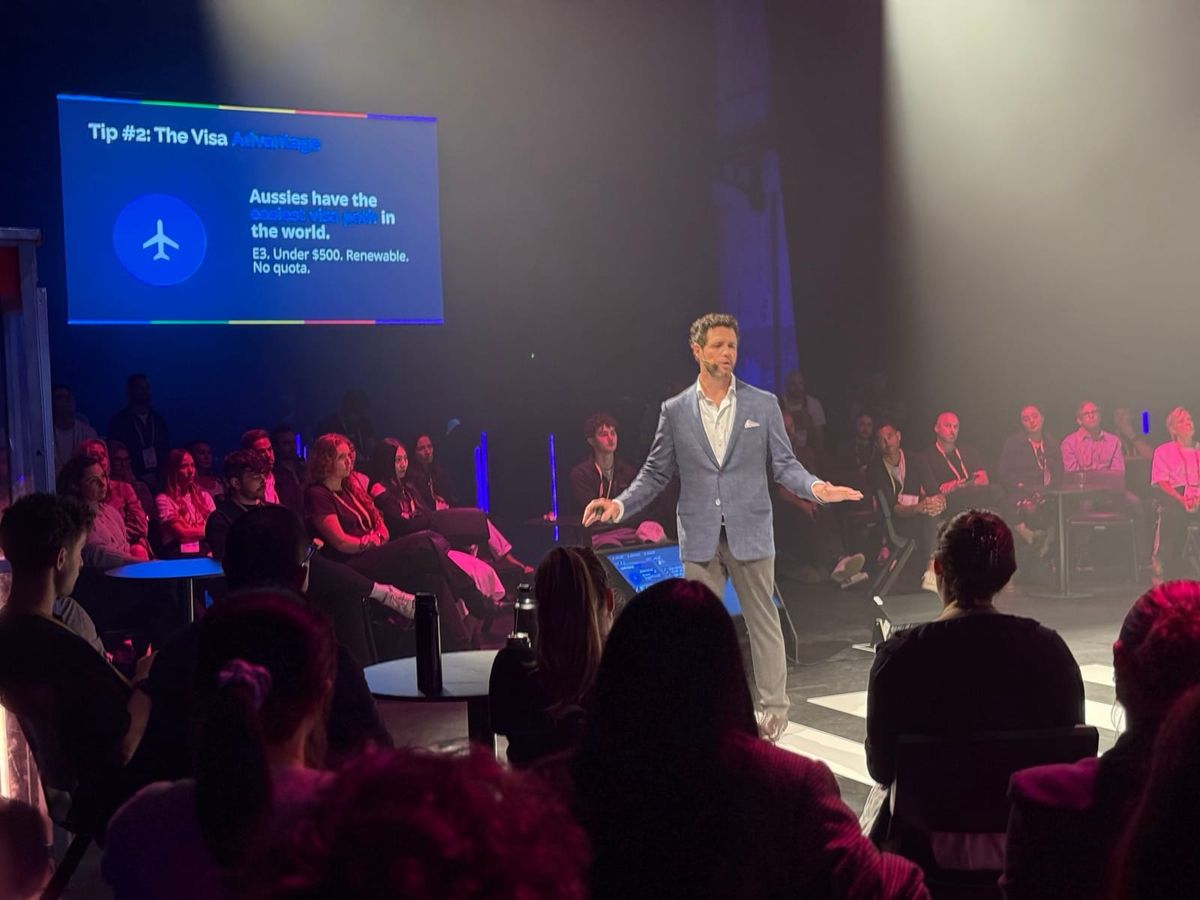
I recently gave a talk at Sunrise about why I think Australian and New Zealand entrepreneurs are world class, why our prosperity is no longer the safe bet it once was, and the practical things I wish someone had told me before I went to the United States to build a company.
For readers outside Australia: Sunrise is the largest annual gathering of the local startup ecosystem. Founders, investors, operators, and friends of the community. It happens at Carriageworks in Sydney, on a stage in a converted railway shed that does a surprisingly good job of holding the room.
While I gladly accepted the invite late last year to speak at an event I had always respected, the fact my family and I decided to move back to Australia after I committed to speak made it even more special. The title I landed on was Insights from a Boomerang. The thesis took a few drafts and putting the talk together took a lot more work than I bargained for!
The talk in written form is below, with each slide above the corresponding section. There's going to be a video at some point in the future and eagle eyes will see I went off script a bit, but what's written here is closer to the talk I wanted to give than the one that came out.
It's early 2006 and I'm sitting in Palo Alto, the heart of Silicon Valley, eating sushi with a prospective angel investor.
Marc Andreessen.
I clearly remember two thoughts from that day. Firstly, "why do people like sushi?" And second, "how on earth are a couple of uni dropouts from Wollongong sitting here pitching the founder of Netscape?". It was surreal.
But here's what I know now, after fifteen years in the US, building and exiting my own startup: we did belong there.
Because if you're world class, no one cares where you're from.
Through my journey, I've learned something I think is true about almost every person in this room.

Australia has eight of the ten most venomous snakes in the world.
This one is the Inland Taipan - deadliest on earth, with venom almost twice as potent as #2.
Why is this scary looking fella so venomous? It's because of the environment he evolved in. Scarce resources. Fierce competition for what little food exists. You don't get many chances to hunt - so when you do, you have to be lethal. Or you die.
I believe the same pressures that forged our wildlife also forged our entrepreneurs.
Let me show you what I mean.
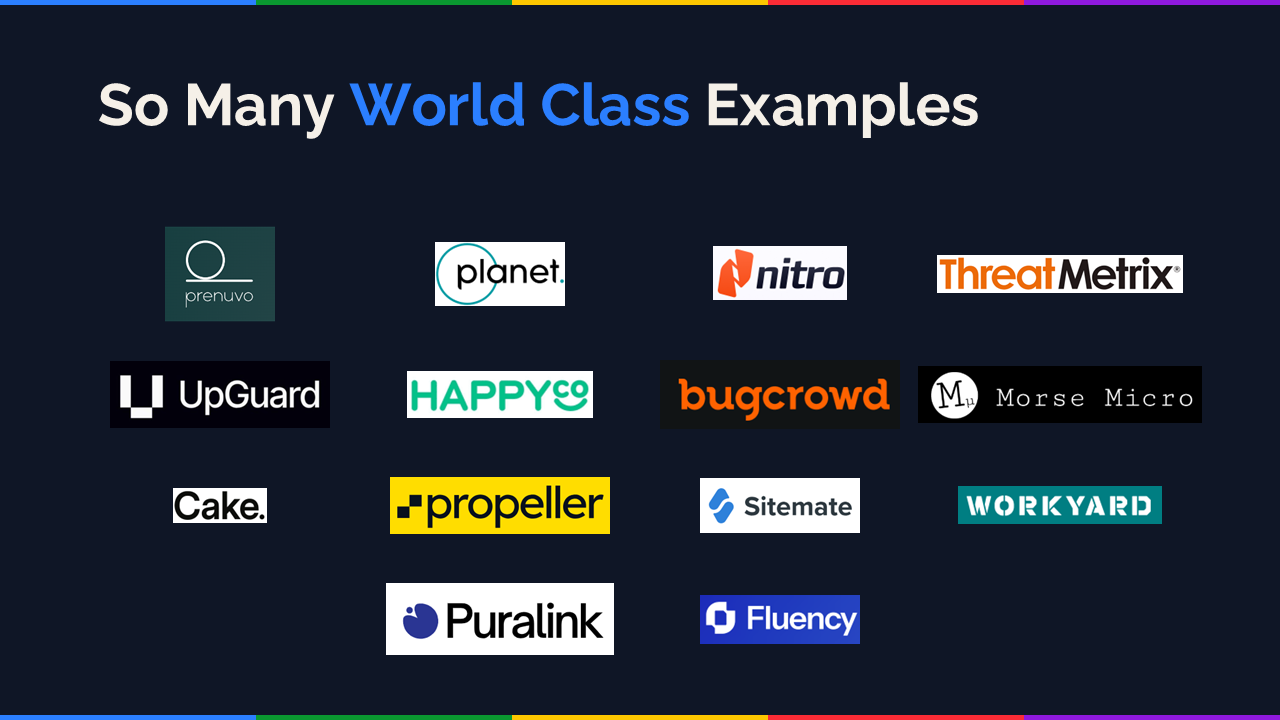
I've had a front-row seat to this happening time and time again.
As a founding mentor and investor in Startmate, I've seen these and hundreds of other startups and their founders up close from very early.
As one of the creators of the Aussie Founders Network, I've gotten to know many other founders, and interviewed people like Andrew Lacy at Prenuvo, Chris Boshuizen at Planet Labs, Cathy Edwards from Chomp, along with many others.
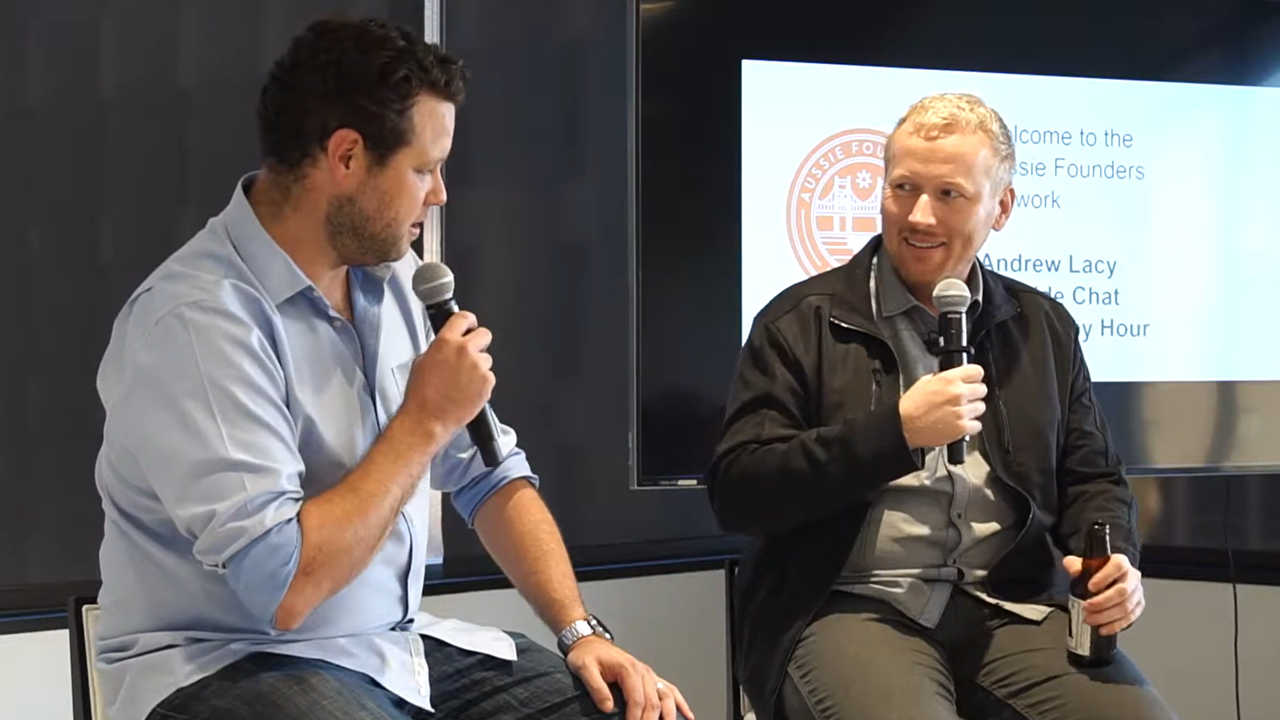
A few years back I sat down with Andrew Lacy.
He's an entrepreneur from Melbourne.
He had early success founding Tapulous, which he sold to Disney in 2010.
When I interviewed him in 2017, he was transitioning from a travel startup that didn't work out, and he was exploring something in healthcare.
He saw a problem: MRIs exist everywhere, but they're locked behind GPs, specialists, insurance. The medical industry is the fire department, but when it's your body you'd prefer to have a smoke detector so you can put out the fire before it does real damage.
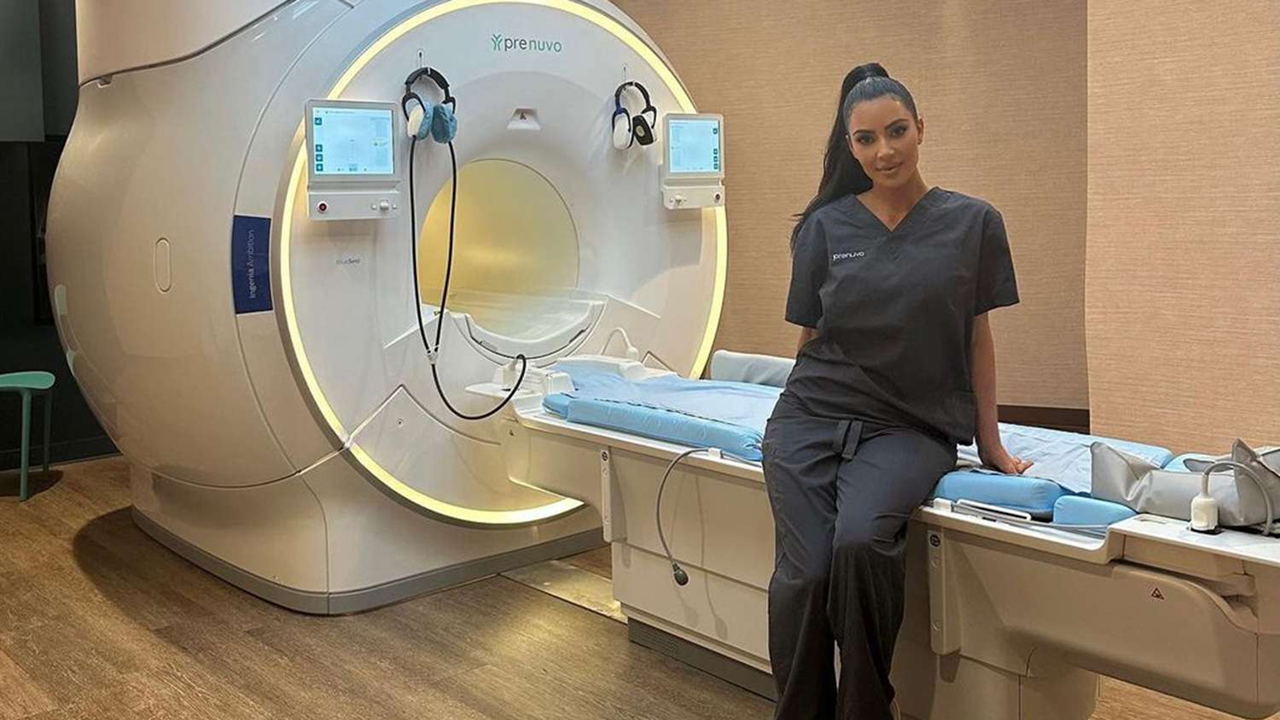
So he came back to the US and founded Prenuvo, a pioneer of whole-body MRI scanning with over one hundred thousand scans and backers like Eric Schmidt, Tony Fadell and Anne Wojcicki.
They're now the largest private whole-body MRI company in the world.
Andrew is a smart, driven and humble Aussie founder. Just like many of the people in this room.
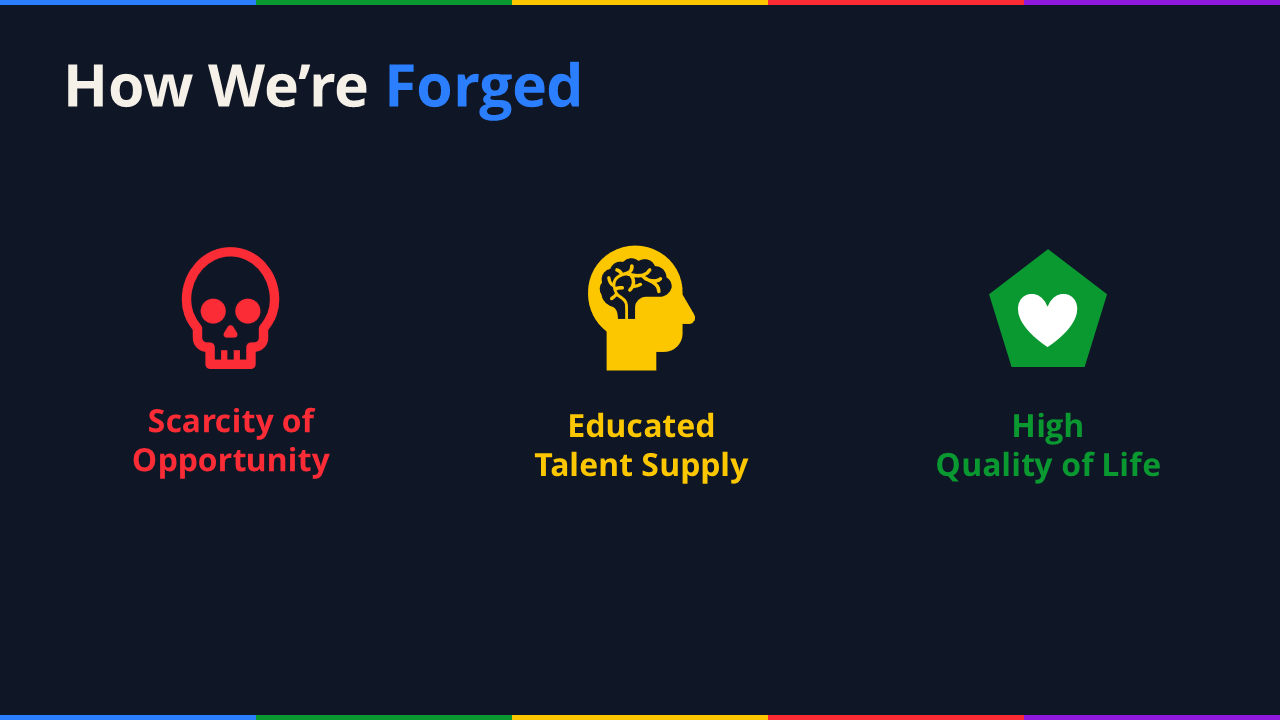
So what is it that forges our entrepreneurs like our wildlife?
Scarcity of opportunity. Like our snakes, there's a real scarcity of opportunity. Small market, far away, dominated by oligopolies.
Educated talent supply. We've also got a lot of competition for those limited opportunities. We've got a world-class education system and an immigration system biased toward skilled people.
Quality of life. We've also got an incredible lifestyle, which means a lot of that world class talent doesn't want to leave, further compounding the competition for scarce opportunities.
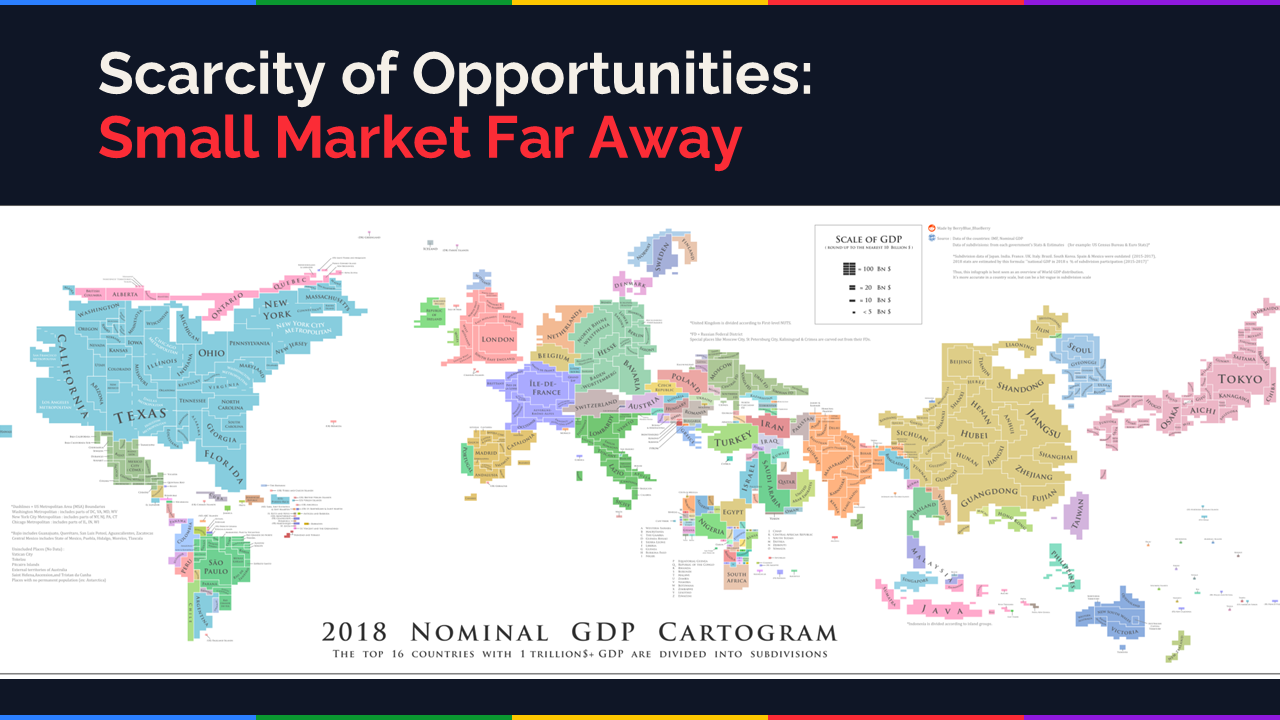
This is a map of the world - but instead of showing land, it shows the size of countries based on GDP.
As you can see, Australia is pretty small and pretty far away. We're less than 1% of the world's GDP.
We have a scarcity of opportunity by virtue of our size and isolation. But it gets worse.
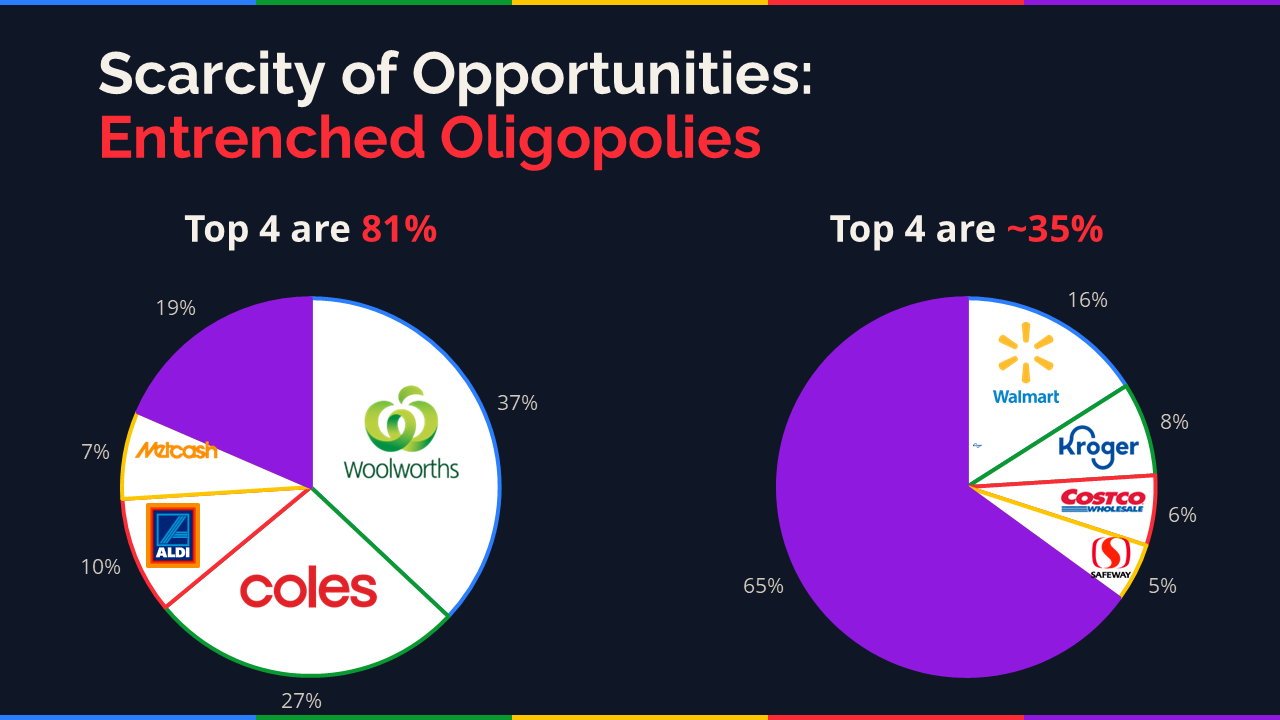
If you're launching a consumer product, distribution is always hard. But in Australia, it's brutal.
Four players control roughly 81% of the supermarket market.
If they don't say yes, you're out of luck. Game over.
But in the US, entrepreneurs can start at Whole Foods or Publix or other regional chains and scale gradually.
That's the oligopoly problem for retail founders.
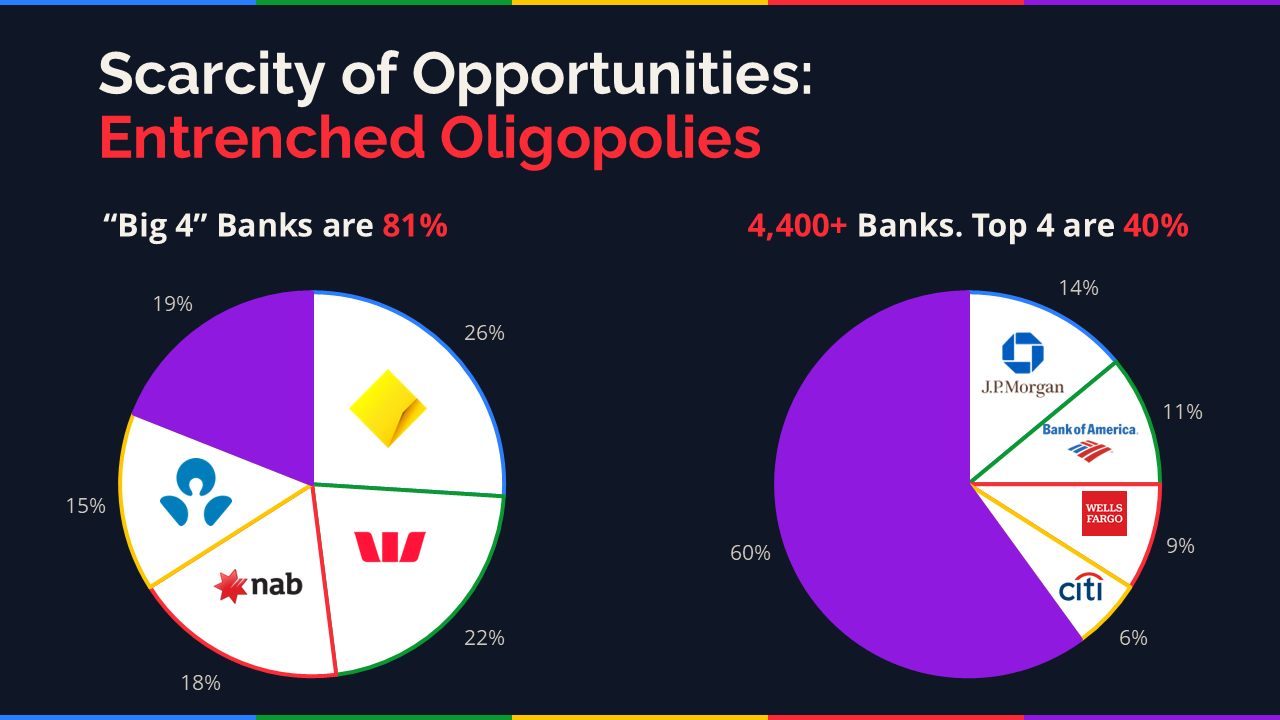
The Big Four Australian banks control about 80% of the market. Compare that to the US - 4,400 banks.
For fintech founders, the banks own the customers, the rails, the game. You need them as partners, for permission to exist. And if you're lucky enough to get one to say yes, the others will probably say no.
It's not just fintech. Having just a few banking options makes it hard to operate. Payment processing, merchant services, basic infrastructure - the incumbents control it.
Do you think the CEO of CommBank has even woken up worried about being disrupted by a startup?
Exactly. That's the problem.
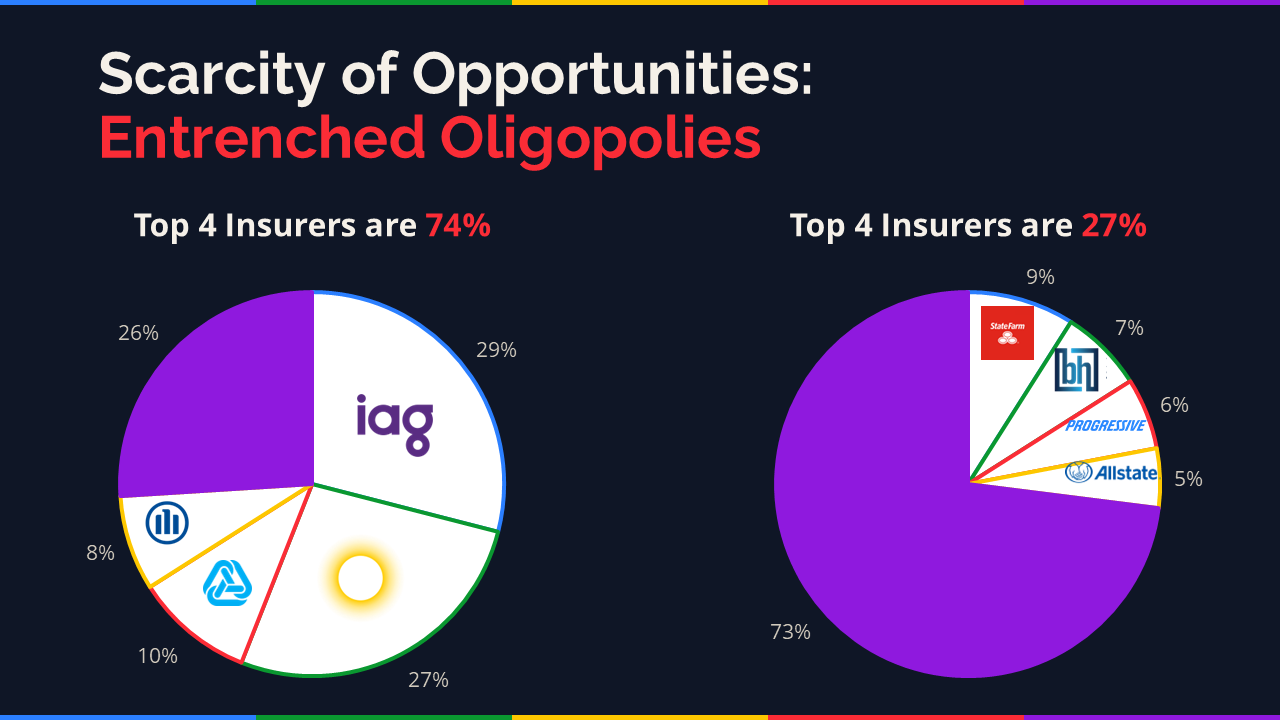
Insurance. Same story. Top four players dominate the market. InsurTech founders hit the same wall as fintech.
It's not just banking. It's the pattern.
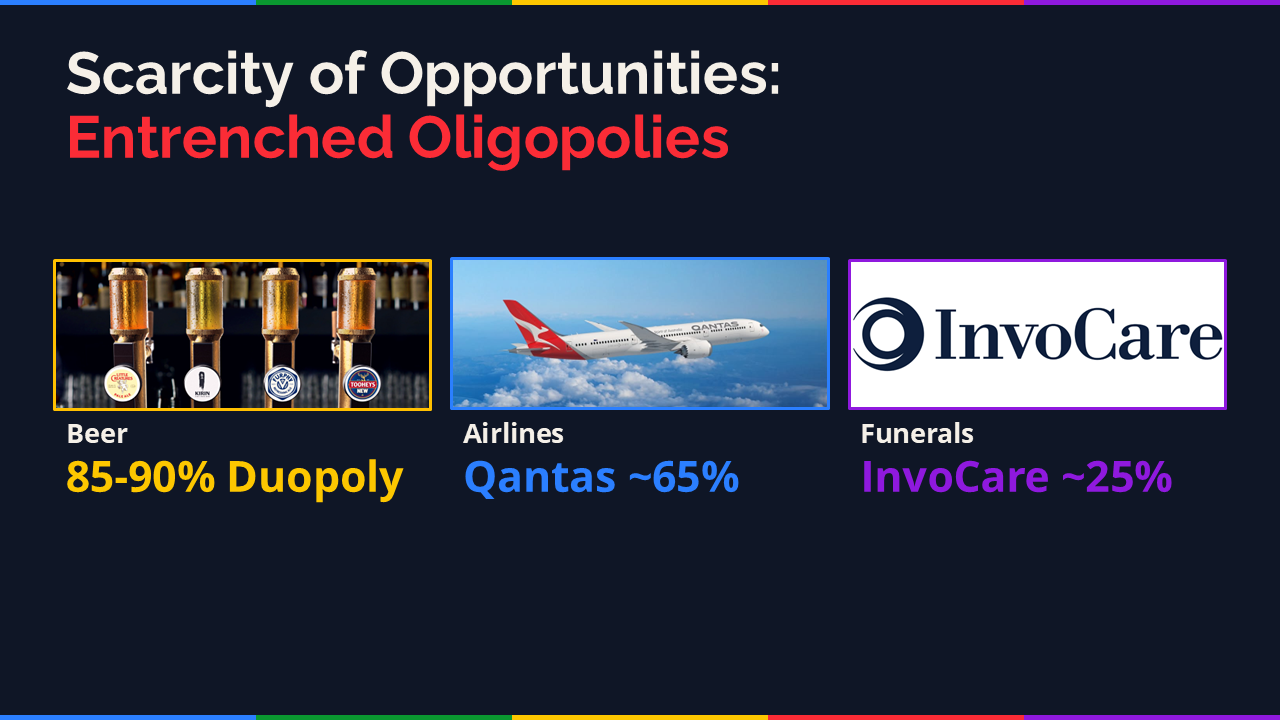
If all of this is enough to drive you to drink? If you want to start a beer company, that's a problem too - 85 to 90% of Australian pub taps are contracted to one of two brewers.
Qantas has two-thirds of the market and they don't feel the pressure to innovate. Heck, they don't even have WiFi more than 20 years after it became widely available!
And they even get you in death. A quarter of the Aussie funeral market is owned by one company, and they're still buying more of it.
In Australia, it's death, taxes, and oligopolies.
But here's the good news.
Remember the Inland Taipan? Lethal because of its environment. The scarcity of opportunity. The competitors and the isolation.
You've been forged in exactly that kind of environment that has helped to make you world class.
And while we know snakes can't go on a plane, you can. And your country needs you to.
Australia has been the lucky country my entire life. Over thirty years without a recession. That's extraordinary.
But counting on luck continuing forever isn't smart.
The conditions that created prosperity for decades are shifting, and some of the things that have made Australia so prosperous are going into reverse.
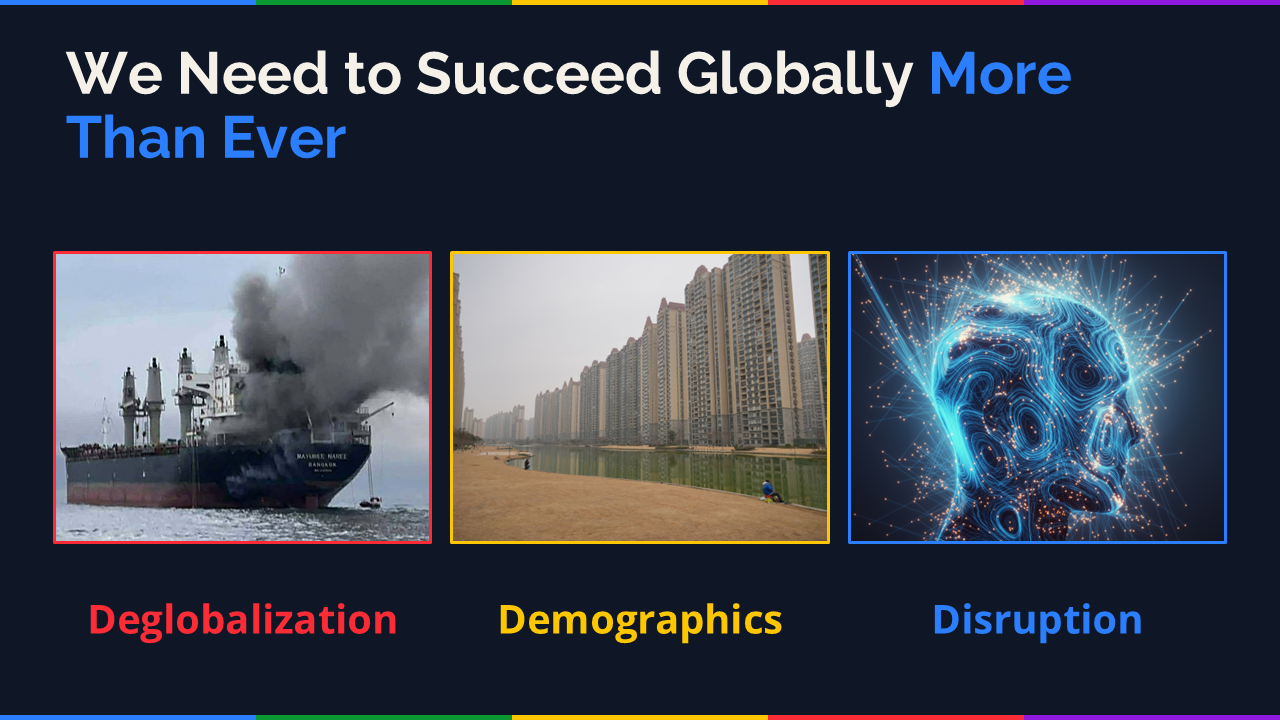
There are three major forces building. And if you care about your country - your family, your community, your future - you need to pay attention.
Because Australia's prosperity isn't something we can take for granted.
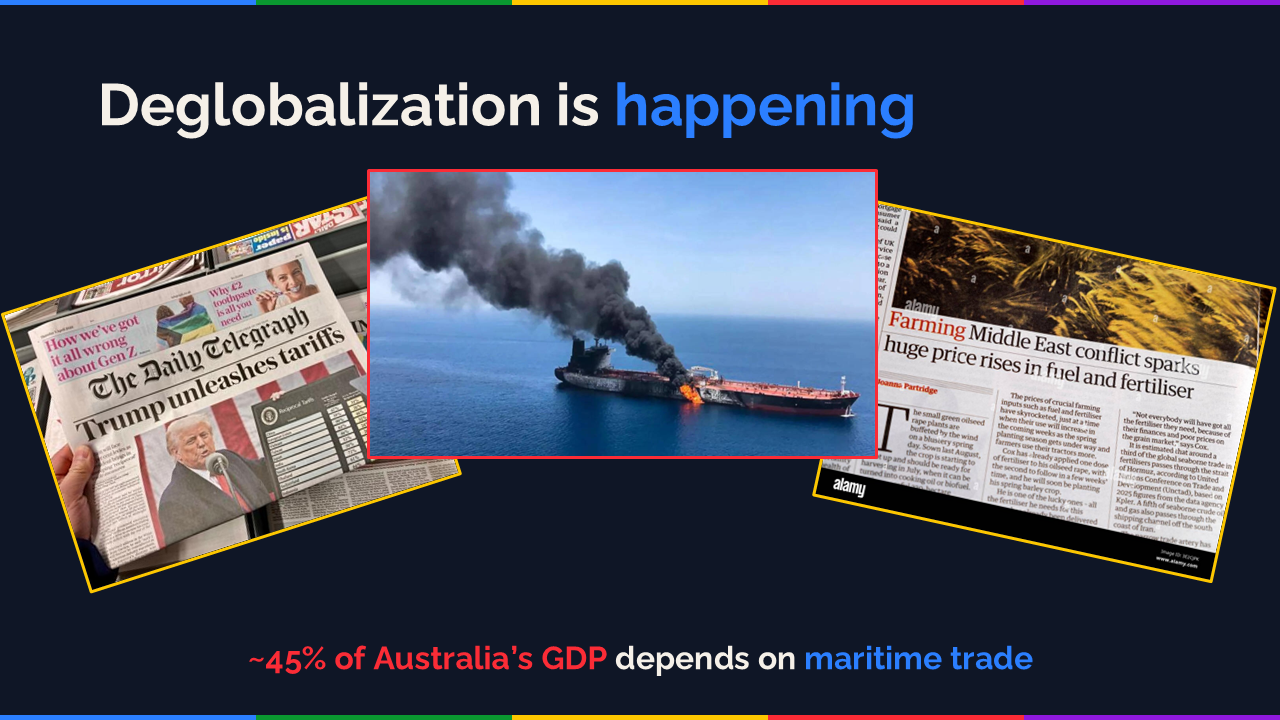
This is a picture of an Indian tanker on fire in the Strait of Hormuz, an international waterway.
For a seafaring nation like Australia - which depends on maritime trade for roughly 45% of GDP - this is very bad.
But this isn't just one crisis. It's the beginning of a trend, and the world's strongest navy is starting to look more like a privateering force.
In addition to the first blockades in decades, we're seeing more and more trade wars and tariffs.
Globalization has made Australia prosperous, but the direction is all one way - in reverse.
The Strait of Hormuz will probably reopen. But there will be other chokepoints, other crises. And we're at the end of a very long supply chain with few alternatives.
Deglobalization is happening. As a small maritime trading nation at the end of very long supply chains, this is bad.
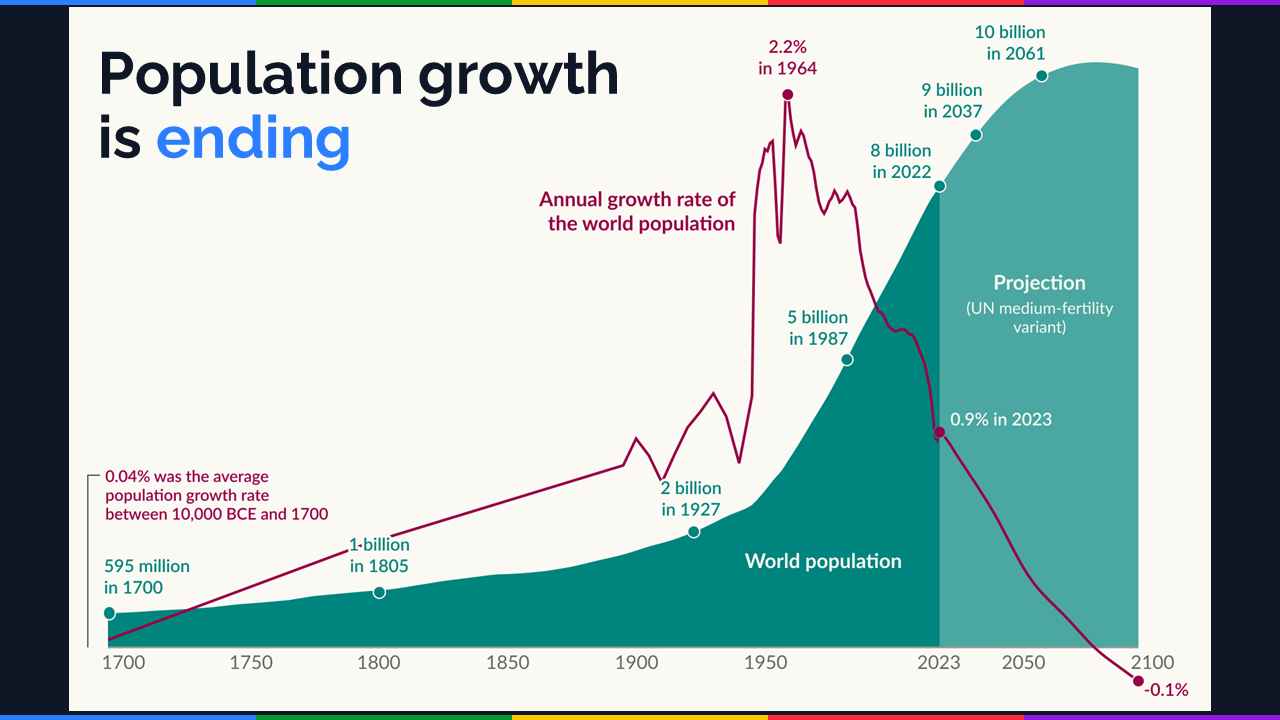
For over 30 years, Australia's prosperity has been built on one thing: over a billion people in Asia being lifted out of poverty. This drove demand for the commodities we export, boosting our prosperity.
But China's population is shrinking. Japan sells more adult nappies than baby nappies. And South Korea has the lowest birth rate in the world.
Once urbanisation and development have pushed fertility rates down, they have never reversed.
When your biggest customer stops growing and starts shrinking, commodity demand doesn't stay the same. That tailwind that's funded Australian prosperity for decades risks becoming a headwind.
We're going to be selling iron ore for the rest of my life, but odds are we'll be selling less for less. If we want to ensure the future is prosperous, we need to find a new way to earn a living.
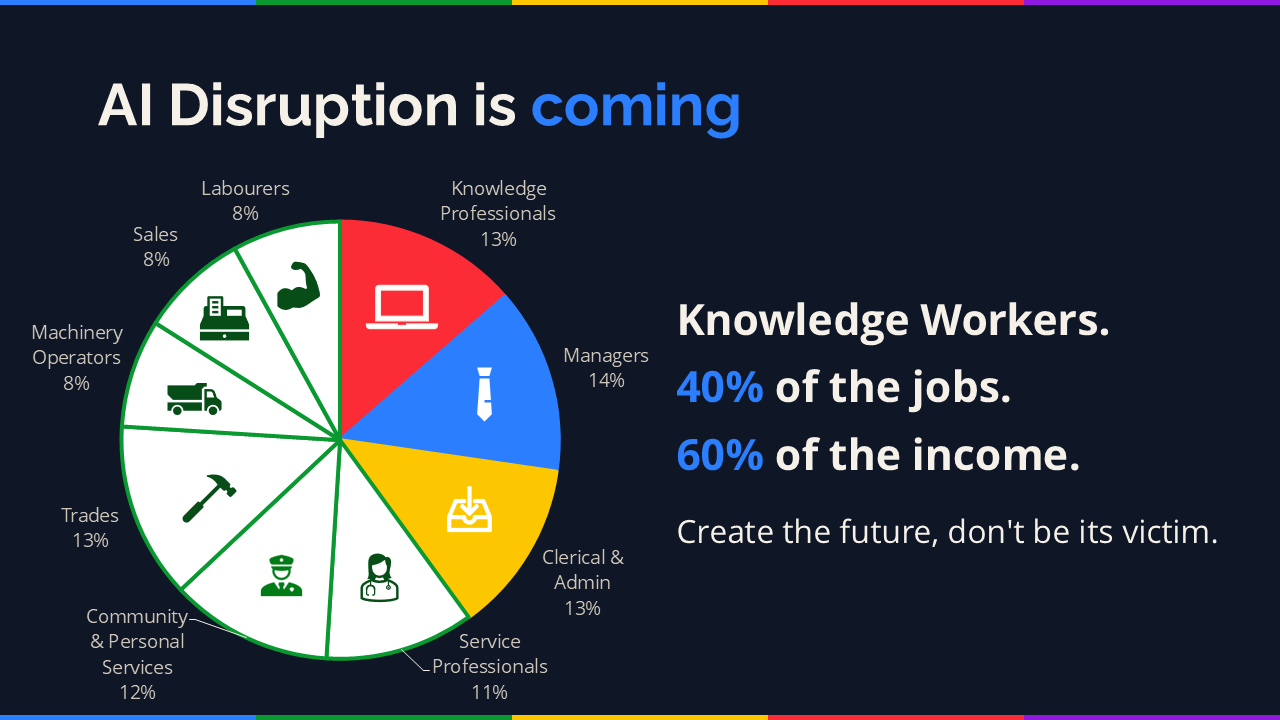
ChatGPT is three years old. We're at the beginning of the AI transition, but last month tech companies laid off over 45,000 employees.
According to ABS data, knowledge workers, managers and clerical staff make up 40% of jobs in Australia. Professionals like lawyers, accountants and of course software developers look to be the most at risk from AI disruption.
And these jobs are well paid, making up 60% of total income.
No one knows how many of these jobs will be disrupted by AI, but just 10% going away would double our unemployment rate.
These people are going to need alternatives, and while the government might help with some "pain management", the solution is going to come from the people in this room creating the new companies.
We need entrepreneurs in this room building globally. Not to rescue people from desperation - to create the future we're all going to need for prosperity.

The last thirty years have been good to Australia - we took the old saying "The Lucky Country" to the next level. Globalization, demographics and technology have been good to us.
But I think the next thirty years are going to be harder. The tailwinds are becoming headwinds.
Which is why, as entrepreneurs, we need to take action. Now.
The best thing you can do is win on the world stage. Not just for yourself, though that's motivating. No, you need to go out and win for your family, your community, your country, to ensure a prosperous future for us all.
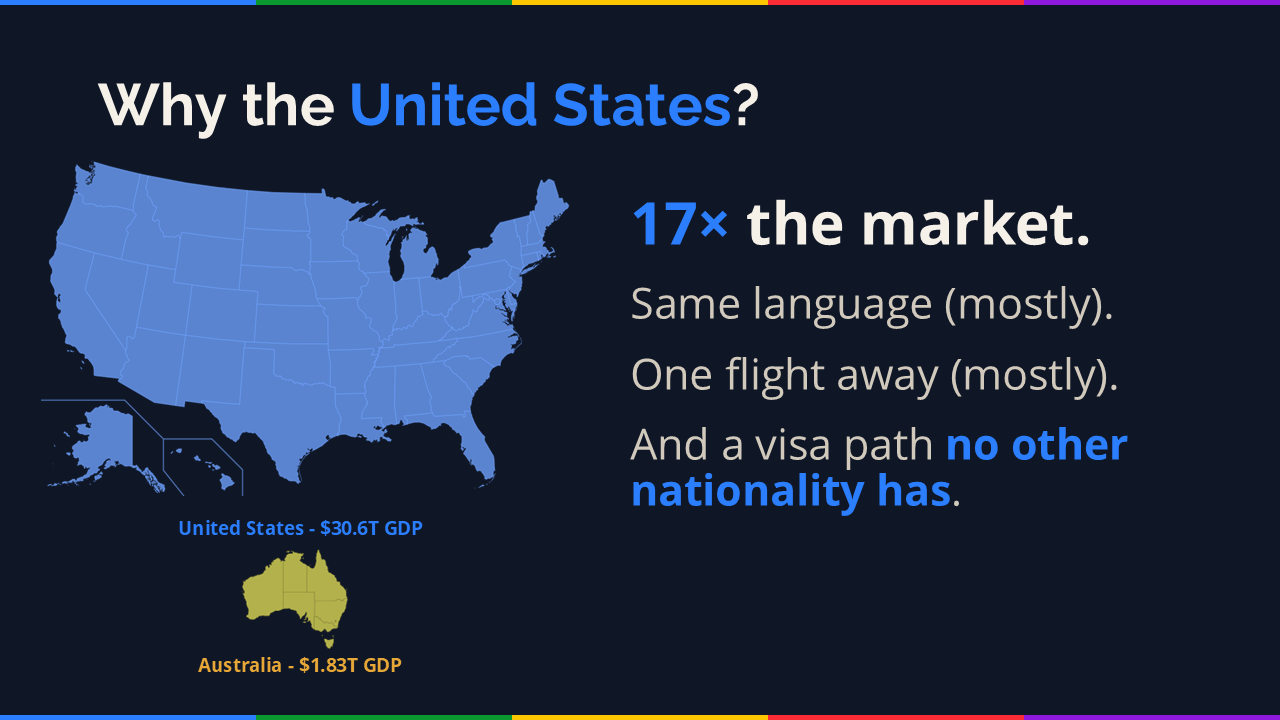
Now, I've been in the US for 15 years, and I know better than most. Around the world, the US brand has seen better days.
But despite the headlines, here's the reality: it's still where the market is.
Australia is one-seventeenth the size of the US. Not the scarcity we're used to. They speak mostly the same language, and they're one flight away for most of us. We've also got a visa no other nationality has.
For our industry, despite your current feelings about the US, it's the only game that matters.
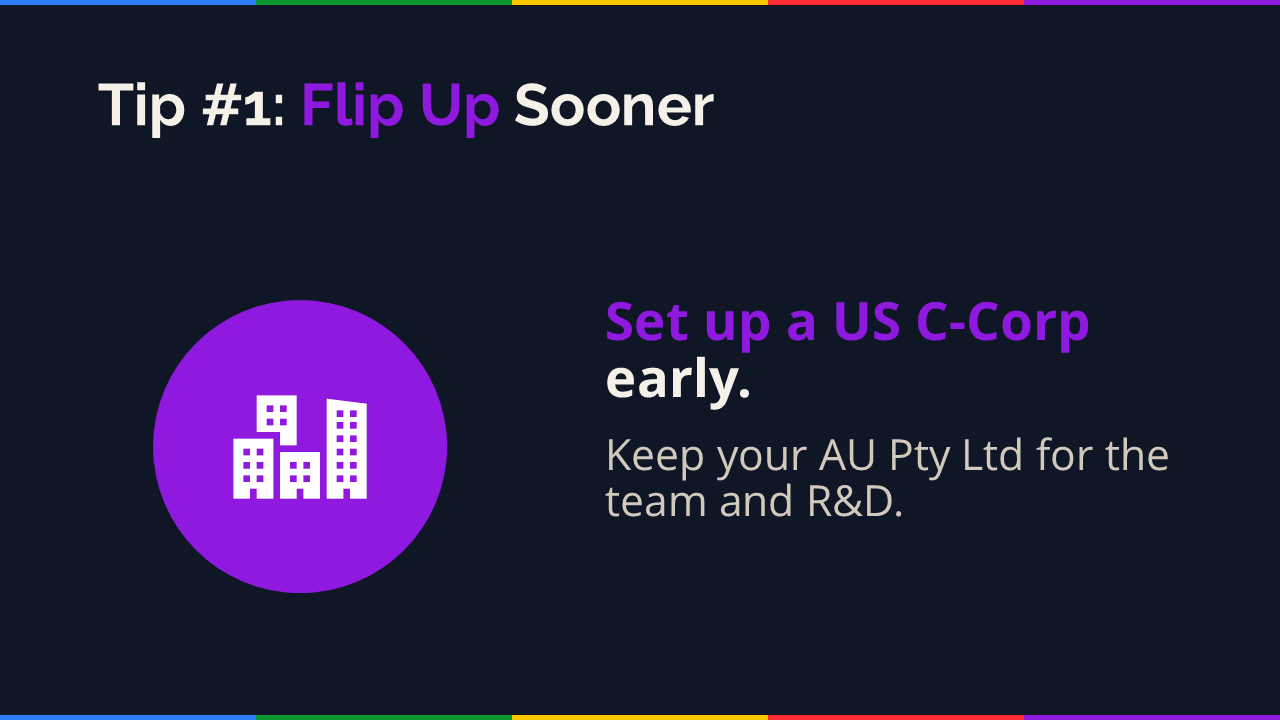
A flip-up is where you take your Aussie company and put a new US company above it, making your Aussie company a wholly owned subsidiary.
You don't lose your Australian company. You keep it, along with your Aussie employees, the R&D tax incentive and everything else. You're just putting a US C-Corp over the top.
Three reasons to flip:
One: QSBS tax benefit. First US$10M in proceeds tax-free if you're a US tax resident at exit. The five-year clock starts from company formation, not when you move. Flip early, the clock runs while you're in Australia.
Two: Operations. A US entity with an EIN (the US equivalent of an ABN) makes it dramatically easier to do business with US customers, invoice in USD, have a US bank account, much better payout rates from Stripe etc. You can operate as a US company without being physically there.
Three: Visa path. You can't get an E-3 visa without a US entity sponsoring you. We'll get to that next.
And critically: US investors are comfortable with a US company. Australian investors are comfortable with both. But US investors get uncomfortable with an all-Australian structure. You cut yourself off from the deepest pockets in the world.
Yes, there's compliance overhead - transfer pricing studies, government paperwork. But you can get by on the minimum until you're big.
Flip up sooner.
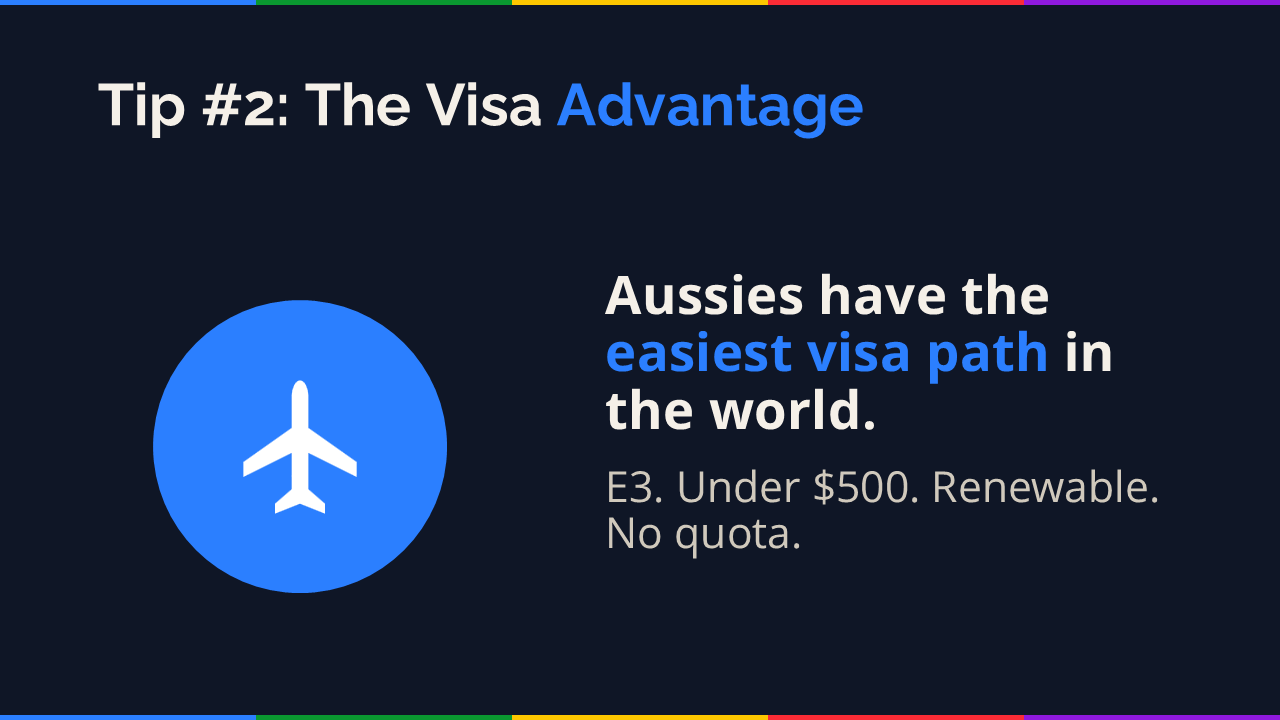
You have a visa nobody else in the world has.
The E-3 was created in 2005 after John Howard negotiated the free trade agreement with the US, post-Iraq. We were supposed to be the first of many allies to get it, which is why it has an annual cap of 10,500 new visas.
But after we got it, the door never opened again. US immigration politics seized up and nothing's gotten through since. We've got the E-3 visa all to ourselves, and we're barely using a third of them.
What it gives you: a work visa for any specialty occupation - anyone with a degree. Two years, renewable indefinitely. I was on one for over a decade. Your spouse can work too (E-3D).
But here's the catch: you need a US entity to sponsor you. Which is why you flip up first. Tip #1 enables Tip #2.
Don't sleep on this. It's the single biggest gift Australian founders have.
Everyone defaults to San Francisco. And if you're selling to tech, if tech is your distribution and partnerships, if investors are the game, yes, go to SF. It's the right call. Big talent pool, keeps attracting inbound migration.
If you're going to look beyond SF, and I recommend it, you don't want to go East of Denver, mountain time.
Austin or New York? On paper, sounds better than SF, but the time zone math is actually worse for culture because for most of the year 9am Sydney = 7pm NYC. No real crossover, your team culture fragments and you'll hate life.
In addition to timezones, look at where your clients are and where the talent is. I've been in Denver for 7 years, and know lots of great startups in Salt Lake City which is cheaper with great salespeople.
Go East Coast only if your customers are there, finance, healthcare, regulated industries where the market actually is. Not for the bright lights.
In the US, the labor market isn't a high-trust environment like Australia. It's transactional. Self-interested. People will tell you they're awesome when they actually suck. Their buddies will vouch for them. You believe it. You hire. It costs you.
It's cost me over $100 million.
So here's what you do: Be ruthless in hiring. Don't trust, verify. Be skeptical. Question everything. Don't believe the candidate or their references, they've all got skin in the game.
And when you make mistakes, and you will, be ruthless in firing. If you have doubts, that's your answer. Fire fast.
I've never met a founder who regrets firing someone too soon. They all regret keeping people too long.
It's uncomfortable if you're from a high-trust culture. But it's the only way to build a successful company in the US.
You belong here. You've got what it takes. You're a founder. There's no reason you shouldn't be giving this a shot on the world stage.
But understand what you're walking into. The US is bigger, more competitive, more ruthless. More opportunities, but way more people fighting to win. You're in a different setting.
Here's how you win: Focus on a niche. Australia rewards generalists because the market's small. The US is massive. You can't be everything to everyone. Pick a niche smaller than you think is viable, you'll find it's massive. Better word-of-mouth that way.
Stay humble. The US is full of self-promoters. Brash claims. We show up differently, high NPS, people actually like us, because we're not like that. Keep it. Quiet confidence. Prove it by being focused and delivering, not by talking.
One last thing: Don't be a tourist. Get to know other founders in your ecosystem, especially other Aussie and Kiwi founders. You don't have the alumni networks Americans do. You're on a shared journey. Build those relationships.
You belong. But earn it. Quiet confidence, focused execution, humble culture.
Twenty years ago, I'd just arrived in Silicon Valley, sitting across from Marc Andreessen.
While that startup failed, my lesson from the last 15 years of living in the US is that if a uni dropout from Wollongong can compete with the best in the world, you can do it too.
Because time and again I've seen the proof: Aussie and Kiwi founders are world class. Not because we're lucky, because of how we're forged. The scarcity. The competition.
But knowing isn't enough. The world needs to see it. Your country needs to see it. The next thirty years won't be like the last thirty. The tailwinds become headwinds, and AI disrupts things still further.
You, the people in this room, belong on the world stage. You've got what it takes. And I believe the future prosperity of your community, your country, depends on it.
So go.
Don't die wondering.
I'm incredibly grateful to Joel and the amazing Blackbird team for putting me on that stage, and to everyone in the room for being the kind of audience that makes all the effort to put together a talk like this - and fly half way around the world to deliver it - worthwhile.