The Signal That Made Me Pivot TeamScore Into WorkSights AI
Why I pivoted TeamScore into WorkSights AI - a founder’s lesson about product-market fit, revealed preference, and discovering the real opportunity.

One of the more humbling parts of building startups is realizing the market rarely cares about the story you started with.
Over the past year I built a product called TeamScore. Technically it worked great, but it turned out the market didn’t care.
The original idea came from something I experienced personally while managing a team member whose performance had quietly slipped. When work moved remote during the pandemic, leaders lost what I’d call peripheral vision into how work was actually happening.
The tools that tried to solve that problem were, frankly, awful. Most of them relied on spyware-style monitoring - screenshots, keystrokes, activity tracking - which treated employees more like suspects than professionals.
I thought there had to be a better way.
So I built TeamScore as a cloud-based platform designed to give leaders visibility into how work was happening without surveillance. No software installed on employee laptops. No screenshots. Just signals from the systems where work already happens - documents, project tools and calendars - combined into a picture of how a team was operating.
From a technical standpoint, the product worked extremely well.
In the first five months of the public beta we processed nearly 8 million activities across 2,500 users in more than 20 organizations. The infrastructure scaled, the integrations worked, and the AI summaries were surprisingly strong. Many beta users told me the daily updates gave them a clear picture of what was happening across their business each morning.
But adoption was disappointing.
After five months in public beta, fewer than 30 organizations had signed up.
That moment is familiar to most founders. You have a product that works, early users who like it, but something about the story isn’t landing with the broader market.
When I started digging into the conversations, two issues became obvious.
The first was framing.
Even though TeamScore wasn’t invasive, the idea of “scoring people” carried baggage. Before signing up, leaders would lean in and ask some version of the same question:
“Are you sure my team won’t know?”
That’s not a great signal. Any product that requires the buyer to summon a bit of courage before they turn it on is pushing uphill.
But the second issue was more important.
TeamScore had been built around the idea that companies were desperate to solve the “remote productivity problem.” But the revealed preference of the leaders I was talking to suggested something different.
If remote work were truly broken enough that companies were desperate to fix it, they would already have bought one of the surveillance tools in the market.
Most hadn’t, and while partly this was to avoid the spyware ick, it was more that they had decided to manage fake-work-from-home manually (or just put up with it).
In other words, TeamScore was fighting the last war - which is rarely a good strategy when you're trying to build a high-growth technology company.
But there was one signal inside the product that kept showing up.
And it turned out to be the clue that changed everything.
The Signal I Almost Missed
While adoption of TeamScore itself was slower than I wanted, the people who were using it kept telling me the same thing.
Their favorite feature wasn’t the scoring.
It was the daily AI summaries.
Every morning they’d get a short briefing about what had happened across their company the previous day. Who had been collaborating heavily. Where projects were gaining momentum. Where things looked stuck. Where a particular team seemed overloaded.
And leaders loved it. It saved them from having to have as many “status update” Zoom calls with their team. It saved them having to spend time going looking for data, and gave them proactive, useful insights so they could be better leaders, more coach than cop.
The more I thought about it, the more it became obvious that this had very little to do with remote work. They weren’t wanting a tool for accountability - they wanted awareness.
Running a modern business is fundamentally an information problem. As companies grow, the leader’s ability to see what’s happening degrades rapidly - there’s just too many people doing too many things. While delegation is great when things are great, when problems emerge the lack of visibility is painful.
The classic solutions to this problem is to implement OKRs, create dashboards, standardize reports, and have regular meetings (anyone who’s done EOS knows the game with the L10 meeting). These approaches aren't wrong, but they all share the same limitations: they’re episodic and manual.
You look at the dashboards when you make time to look at them. You get the report when someone prepares it. Your weekly exec team meeting is where people bring up problems big enough to demand attention.
Which means the gap between signal and awareness is often weeks.
And as companies adopt AI and execution speeds up, that latency becomes more dangerous - a lot more can happen in a business where work is being done 2x or 5x faster than before, and if insights are still episodic and manual, then the leaders become an even bigger bottleneck to business performance.
So the more I looked at how people were actually using TeamScore, the more obvious something became.
The scoring wasn’t the value.
The real value was that leaders were getting continuous insight into how their business was operating.
The Real Opportunity
At the same time I was seeing this, another trend was becoming impossible to ignore.
Not only was AI dramatically accelerating how individuals work, the concept of always-on AI through the “Claw” style products was taking off. Individuals were harnessing AI to be more than a intelligent response to a chat prompt.
So I started thinking about what a Claw-like system might look like if it were designed for a business instead of an individual.
Instead of waiting for a prompt, it would run continuously in the background. Instead of starting each interaction from scratch, it would develop memory about the business and the people doing the work. And instead of relying on reports or summaries that someone had to prepare, it could see the raw signals of the organization directly and make sense of them in real time.
And then I started getting really excited. AI is speeding up the rate of work in businesses, but it hasn’t really changed how leaders run businesses. It turns out the most important part of a business - the performance of leaders - is still constrained by human bandwidth at a time when everything else is accelerating.
And this gap is only going to widen.
And once I saw it, it became clear that this was a much bigger opportunity than remote work visibility.
The Pivot
Once that became clear, the decision was actually fairly straightforward.
TeamScore had been built around the idea of measuring individual activity.
But the part of the system that users loved was the organizational intelligence layer - the part that synthesized signals across systems and turned them into insights for leaders.
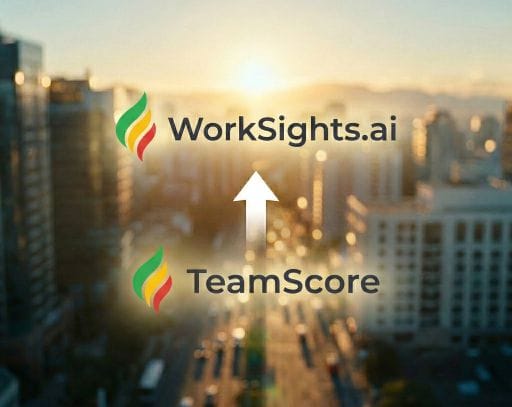
So, I pivoted, and TeamScore is now WorkSights AI.
The goal of WorkSights AI is simple: use AI to give leaders continuous visibility into how their business is actually operating.
It runs quietly in the background, analyzing how work is actually happening across your business, surfacing the insights you need to make better decisions with confidence.
WorkSights AI is designed to help leaders run a business with AI.
What This Taught Me
One of the more humbling parts of building startups is realizing that the market rarely cares about the story you started with. You can believe your “why” is righteous and compelling all you like, but the market doesn’t care unless it does.
While TeamScore feels like a failure, it really wasn’t - without it, I wouldn’t be in an amazing position with the connectors and the insights and the platform to deliver WorkSights AI over the next few weeks.
But more importantly, without building it, I never would have discovered how powerful the daily AI summaries were, or how strongly leaders responded to having continuous awareness of their organization.
That signal only appeared once the product existed.
This is why I often talk to the founders I mentor about revealed preference. What people say they want is interesting. What they actually do is what matters.
What Happens Next
Right now WorkSights AI is still early.
The daily summaries that started this whole realization are just the beginning.
In the coming weeks we’ll be expanding the platform with many more background AIs that users can configure and tune for their business. We’ll also be introducing a live prompt experience built on the platform’s organizational memory, along with many more connectors and capabilities over time.
If you're curious about where this is going, I’ve written more about the vision for the platform in the WorkSights launch post.
The goal isn’t to replace leadership - it’s to expand leadership capacity.
Because if AI is going to accelerate how work gets done, the people running businesses need tools that help them keep up.
Otherwise the organization eventually outruns the humans trying to steer it.
That seems like a billion dollar problem worth solving.